A final score can show that a child struggled with a memory task. It does not explain what happened along the way. In this study, we use click-by-click records from Honey Memory to examine patterns in memory, errors, response changes, and spatial search.
The task and the questions
Honey Memory shows a set of target hexagons for a few seconds. The board then clears, and the player tries to select the targets from memory. The study analyzed data from 174 children aged 7–10 at two clinics and two schools.
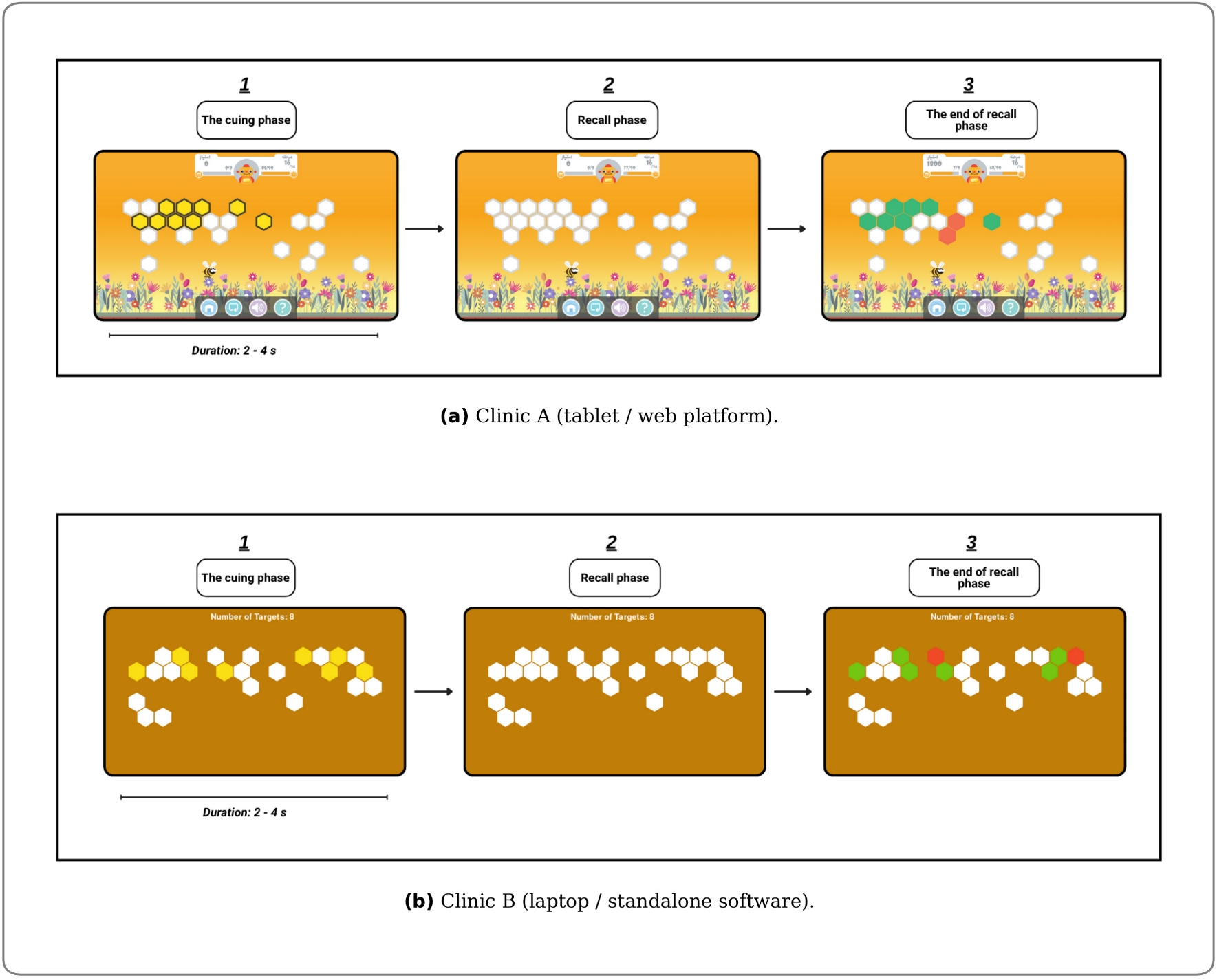
We measured more than accuracy. We looked at working-memory span, clusters of mistakes, changes between correct and incorrect responses, variation from trial to trial, response timing, and the path of spatial choices. We also asked whether task difficulty changed how clearly these patterns separated the groups.
What we found
Children with ADHD tended to have shorter memory spans and lower accuracy. They also showed more runs of consecutive errors, more switching between correct and incorrect responses, and greater trial-to-trial variation. Their spatial search patterns differed as well. Several group differences were clearest at medium difficulty.
The click sequence gives a more detailed picture of how children approached the task. Two players can finish with the same score even if one makes several mistakes in a row and the other alternates between correct and incorrect choices. Honey Memory let us study those patterns alongside what children remembered and where they searched.
Clinic B data are available in the study dataset repository.
Paper
Arabzadeh, M., Shokravi, K., Shahangian, S. A., Zakani, Z., Kambarani, N., Bahrami Esfarjani, Z., Kabki, M., Vahabie, A.-H., & Moradi, H. (2026). Beyond accuracy: Interpretable behavioural profiling of children with ADHD using a visuospatial working memory game. Journal of Neurodevelopmental Disorders. https://doi.org/10.1186/s11689-026-09727-8